


X Tank variants explained
James Daykin2026-03-04T15:34:04+00:00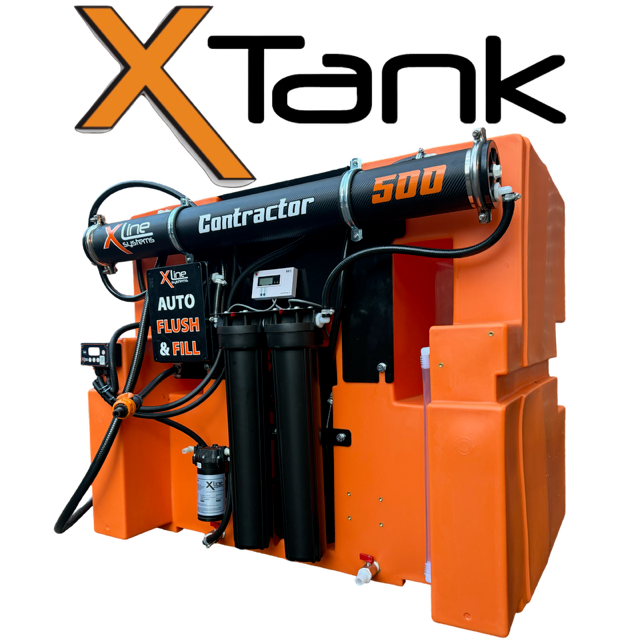
Choosing the Right System for Your Business
The Xline X Tank Range is a modular, vehicle-mounted water purification system available in capacities from 350 litres to 1000 litres, supporting both single and dual operator setups.
Designed to suit different operational needs and water types, the range is available in three core system configurations, with the multi-stage (RO) model further divided into three electronic variants: Classic, Contractor, and Professional.
This guide explains the differences so you can choose the most cost-effective and efficient setup for your business.
- Delivery-Only Unit (No Filtration)
This model is designed purely as a delivery system. It contains no onboard filtration and is filled with purified water via the tank lid.
How It Works
A separate static filtration system purifies water at a fixed location. Holding tanks are filled at that site, and purified water is then transferred into the vehicle’s delivery tank.
Ideal For:
- Multi-vehicle fleets
- Businesses wanting to maintain one central filtration system
- Operators looking to reduce maintenance across multiple vans
This approach eliminates the need to maintain separate filtration systems in each vehicle.
- Single-Stage DI (Deionisation) System
The DI system purifies water in a single stage using resin to remove Total Dissolved Solids (TDS).
Why Choose DI?
- No wastewater produced (unlike RO systems)
- Faster tank filling
- Lower initial setup cost than a multi-stage RO system
Important Considerations
DI systems are best suited to soft water areas where tap water reads below 60 ppm (parts per million) TDS.
In harder water areas:
- Resin depletes quickly
- Running costs increase
- Operating costs may outweigh revenue benefits
While the upfront investment is lower than a four-stage RO system, daily running costs can be significantly higher, particularly in hard water regions.
- Multi-Stage RO (Reverse Osmosis) System
The RO system is the most advanced purification method in the Xline range.
It includes:
- Multi-stage pre-filtration
- RO membrane filtration
- Final DI polishing stage
Key Advantages
- Produces ultra-pure water in all water types
- Ideal for hard water areas
- Annual running costs as low as £200–£300
- Capable of producing tens of thousands of litres per year
- Typically pays for itself within 12–24 months
Considerations
- 40–50% of input water is discharged as waste
- Produces approximately 150–170 litres per hour
Despite higher initial investment, the RO system is the most cost-effective long term solution for most operators.
RO Model Variants: Classic vs Contractor vs Professional
All three variants use the same four-stage filtration process and produce the same water purity and fill rates.
The difference lies in:
- Electronics
- Level of automation
- Human intervention required
- Running cost optimisation
The Classic
A mechanically operated system with minimal electronics.
Key Characteristics:
- Manual flush before each fill cycle
- Manual product-to-waste ratio adjustment
- Manual hourly maintenance flushing
- Manual float valve shut-off
- Water continues discharging to waste until mains supply is turned off
Running Costs:
Medium — dependent on operator habits.
Best For:
Operators comfortable with manual control and looking for lower upfront cost.
The Contractor
Designed for efficiency and reduced human error.
With one press of a button, the system manages the entire fill cycle automatically.
Key Features:
- Automatic flush at start of cycle
- Automatic product-to-waste ratio adjustment
- Automatic hourly maintenance flush
- Automatic shut-off when tank is full
- Waste discharge stops automatically
Running Costs:
Consistent and reduced due to programmed optimisation.
Best For:
Busy operators who want reliability, automation, and reduced oversight.
The Professional
The pinnacle of performance in the Xline range.
Includes all Contractor features plus an advanced DI Saver system.
What Is the DI Saver?
Each time an RO membrane flushes, high TDS water is released.
In standard systems, this passes through the DI resin, reducing resin life.
The Professional model diverts this high TDS water away from the DI resin and directly to waste — significantly extending resin life and reducing running costs.
Key Features:
- Automatic flushing
- Automatic product-to-waste ratio
- Automatic hourly maintenance
- Automatic shut-off
- Integrated DI Saver protection
Running Costs:
Ultra-low and highly optimised.
Best For:
High-volume users and businesses operating in hard water areas who want maximum efficiency and lowest long-term costs.
Comparison Chart: Classic vs Contractor vs Professional
Feature | Classic | Contractor | Professional |
Automatic Flushing | ❌ Manual | ✅ Yes | ✅ Yes |
Automatic Waste Ratio Set | ❌ Manual | ✅ Yes | ✅ Yes |
Automatic Hourly Maintenance | ❌ Manual | ✅ Yes | ✅ Yes |
Automatic Shut-Off | ❌ Manual Float | ✅ Yes | ✅ Yes |
DI Saver Technology | ❌ No | ❌ No | ✅ Yes |
Human Intervention Required | High | Low | Very Low |
Running Cost Efficiency | Medium | Optimised | Ultra Low |
Which System Is Right for You?
- Delivery Only → Best for fleet operations with centralised purification
- DI System → Ideal for soft water areas and lower startup budgets
- RO Classic → Manual control with lower initial cost
- RO Contractor → Automation and reliability
- RO Professional → Maximum performance and lowest long-term running costs
If you’re operating in a hard water area and planning long-term growth, the RO Professional typically provides the strongest return on investment.